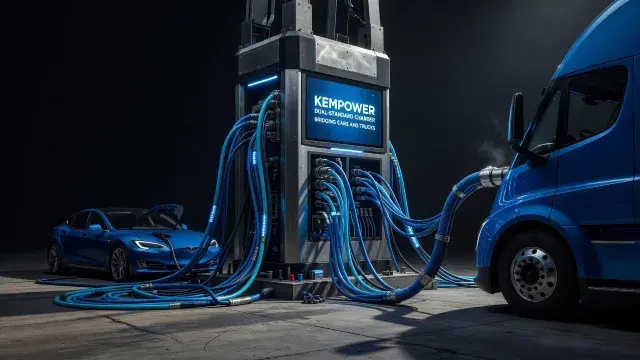
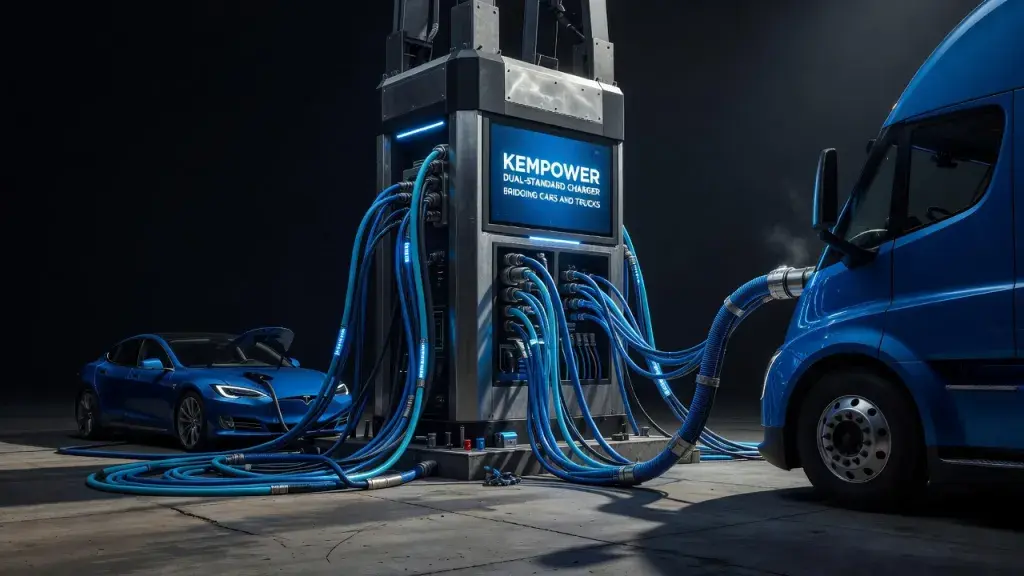
Kempower has introduced a charging unit designed to serve both passenger electric vehicles and heavy-duty electric trucks from the same piece of hardware. The Mega Satellite Flex, unveiled this week at the ACT Expo during the company's Unplug & Recharge event, supports the current CCS standard at up to 560 kW and the emerging Megawatt Charging System at up to 1.2 MW. It's the first Kempower dispenser built to handle either protocol, a distinction that matters more than it might first appear.
The charging industry is caught between two eras. CCS, the Combined Charging System, remains the dominant standard for cars and light commercial vehicles across North America and Europe, but it was never engineered for the power demands of long-haul trucking. MCS is the answer: a newer protocol capable of delivering electricity fast enough to make electric trucking viable on tight schedules. The problem for site operators has been that building for one standard usually means building again later for the other. Buyers comparing hardware options before committing to a site layout may want to check current pricing as they weigh the cost of dual-protocol infrastructure against sequential buildouts. check current pricing
One Site, Two Vehicle Classes
Kempower's pitch is straightforward: install once, serve both. The Mega Satellite Flex can deliver up to 700 amps for CCS and up to 1,500 amps for MCS, with a 5-meter cable for cars and a shorter 2.7-meter cable suited to truck charging ports. That range means a single dispenser placed at a travel plaza or logistics hub could plausibly charge a sedan in one bay and a semi-truck in the next, without operators needing to predict which vehicle type will dominate demand years down the road. The unit also accommodates 800-volt architectures now appearing in newer EVs, which can pull higher charging speeds when the supporting hardware allows it.
An optional payment terminal is available, a detail that matters for public charging sites where card or contactless payment is often the deciding factor in whether a driver stops at all.
Why Utilization Matters More Than Peak Power
The economics of public charging hinge less on headline power figures than on how often a unit is actually in use. A charger capable of 1.2 MW is worth little if it sits idle because only cars pass through, or if trucks arrive and find no compatible hardware. By serving both vehicle classes, Kempower is betting that operators can push utilization higher from the day a site opens, rather than waiting years for truck traffic to justify a second installation. That directly affects payback periods, which remain one of the biggest hurdles for anyone investing in high-power charging infrastructure.
The company has also designed the Mega Satellite Flex to work within its existing distributed charging architecture, where a central power unit feeds multiple satellite dispensers. That compatibility means operators already running Kempower systems can add the new unit without redesigning their electrical infrastructure from scratch.
What Comes Next
The Mega Satellite Flex is scheduled to reach the North American and European markets in July 2026, giving fleet operators and charging network developers roughly a year to plan deployments around it. Whether MCS becomes the dominant standard for electric trucking the way CCS did for cars is still an open question, but hardware that hedges against either outcome is likely to appeal to operators wary of picking the wrong side of an unresolved standards race.